
From Gut Microbiota Dependence to Exo-Biotransformation:
Hughes Postbiotic “Polyphenol Precursor” Reshape Precision Delivery to Reduce Interindividual Response Variability
Hughes Biotechnology | Director of Business Development | Claire Fang
CORE PERSPECTIVE |
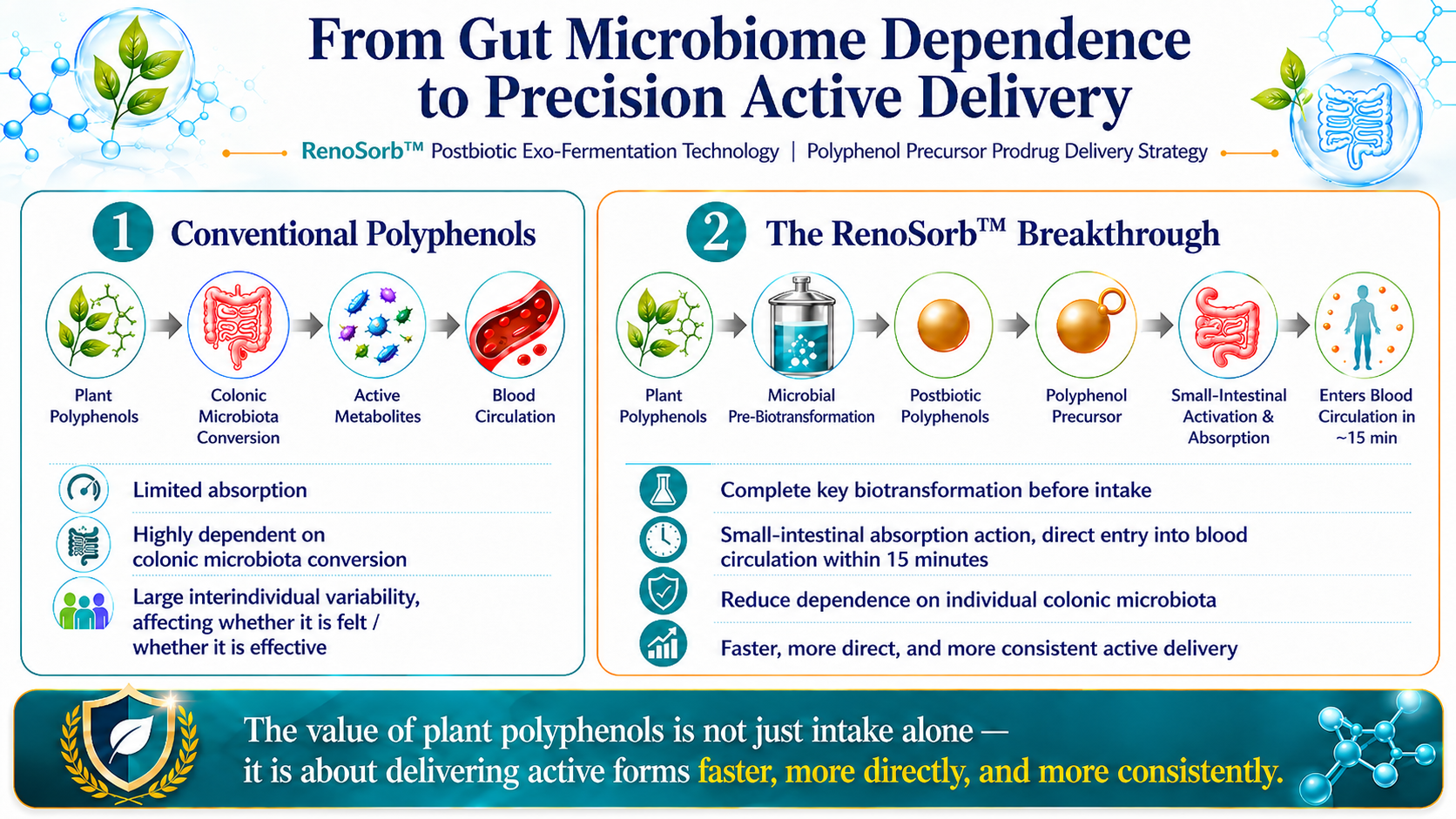
The limitations of conventional polyphenols extend beyond low absorption: conversion into active forms often depends heavily on the colonic microbiota. Because gut microbial composition, metabolic capacity, and active-metabolite production vary substantially between individuals, even the same source and amount of plant polyphenols may be transformed, absorbed, and translated into physiological effects differently from person to person. In simpler terms, these differences may be one of the key reasons why consumers perceive that a product “works” for some people but “does not work” for others.
The breakthrough of Hughes’ patented RenoSorb™ postbiotic exo-fermentation technology is to complete critical microbial biotransformation of plant polyphenols before ingestion, generating postbiotic polyphenol forms. RenoSorb™ goes a step further by converting these polyphenols into “polyphenol derivatives” with distinct absorption advantages, establishing a differentiated pharmaceutical-grade absorption strategy. By shifting key activation and absorption processes forward to the small intestine, marker derivatives produced using RenoSorb™ technology show rapid systemic appearance, detectable in the circulation approximately 15 minutes after ingestion, while reducing reliance on individual colonic microbial transformation capacity.
The value of plant polyphenols is therefore no longer framed simply as “taking them is enough” or “more is better,” but as achieving more efficient and more consistent delivery of active forms—reducing dependence on complex and highly individualized intestinal transformation conditions and increasing the opportunity for meaningful health effects to be realized.
The Real Bottleneck of Plant Polyphenols: Not Simply “Whether We Consume Them,” but “Whether the Body Can Transform and Absorb Them”
Polyphenols are a large class of naturally occurring compounds widely found in plant foods, including vegetables, fruits, tea, and coffee. In plants, polyphenols participate in multiple physiological processes such as signaling, growth regulation, ultraviolet protection, and defense responses. Because many of these compounds possess free-radical-scavenging properties, they have been extensively studied for their potential roles in antioxidant, anti-inflammatory, antimicrobial, anticancer, and other health-related effects. Accordingly, dietary polyphenols have long attracted substantial attention in nutrition and biomedical research for their potential contribution to health maintenance and chronic disease risk reduction. However, as research into polyphenol absorption, metabolism, and the gut microbiota has advanced, scientific attention has gradually shifted from simply asking “how much polyphenol is consumed” to asking “how much can ultimately be transformed into active metabolites that are effectively utilized by the human body.”
In May and July 2026, two high-impact scientific reviews were published in The Journal of Nutrition, a representative professional journal in nutritional science associated with the American Society for Nutrition (ASN). From the perspectives of ”microbial-derived polyphenol metabolites” and “microbial biotransformation”, these reviews re-examined the absorption, metabolism, and interindividual variability of dietary polyphenols. They highlighted that the health effects of many dietary polyphenols can be constrained by two major factors: low bioavailability and variability in gut microbial transformation. Jiang et al. reported that only an estimated 5–10% of dietary polyphenols are absorbed in the proximal gastrointestinal tract, while most reach the colon and undergo microbial biotransformation. The resulting microbial-derived metabolites often exhibit favorable bioavailability, metabolic stability, and biological activity. In other words, for many dietary polyphenols, the amount consumed does not directly reflect the body’s eventual exposure to active compounds; microbiota-mediated biotransformation is one important factor influencing bioavailability and interindividual response.
Gut Microbiota Composition and Metabolic Capacity: A Major Source of Why Polyphenol Supplementation “Works for Some but Not for Others”
The review by Vita et al. indicates that differences in gut microbiota composition can influence polyphenol metabolism and intervention responses, giving rise to distinct metabolic phenotypes, or metabotypes. With the same polyphenol, some individuals may convert a large proportion into active metabolites, whereas others may be low producers or may even lack the capacity to generate a specific active metabolite. Jiang et al. further categorized this variability into two typical patterns: one in which all individuals generate the same metabolite but in different amounts, and another characterized by a clearer producer/non-producer distinction, in which only some individuals possess the relevant metabolic capacity.
More importantly, these metabotypes are not merely biochemical classifications; they may also be reflected in actual human health responses. Vita et al. summarized multiple human studies showing that different metabotypes are associated with different health outcomes, with S-equol metabolism from soy isoflavones representing one of the most illustrative examples. Daidzein can be converted by specific gut microbes into S-equol. Compared with daidzein, S-equol has greater chemical stability, better intestinal absorption, and stronger estrogenic activity. However, the literature indicates that only approximately 20–30% of Western adults and 50–60% of East Asian adults are equol producers. Thus, even when the same amount of daidzein is consumed, the amounts of S-equol and other downstream metabolites ultimately generated can differ substantially between individuals. Equol-producer status has also been associated with differences in responses to soy isoflavone interventions, including menopausal and cardiometabolic outcomes.
Similar patterns have been observed in other polyphenol metabolic pathways. For example, urolithin A-producing metabotypes have been associated with more favorable lipid, glycemic, and inflammation-related markers in pomegranate or walnut intervention studies. Together, these human findings suggest that microbiota-related differences extend beyond whether a specific metabolite can be produced; they may also influence the magnitude of active-metabolite exposure and the health response ultimately observed in an individual. This moves the concept of metabotype beyond microbiology alone and makes it increasingly relevant to precision nutrition and personalized health interventions.
Across many examples, the forms with more favorable bioavailability and physiological activity are often not the compounds in their original ingested state, but metabolites generated through microbial biotransformation. Proanthocyanidins, for example, can be converted into lower-molecular-weight phenolic metabolites; trans-resveratrol can be transformed into dihydroresveratrol; olive-derived polyphenols can be metabolized into hydroxytyrosol, tyrosol, elenolic acid, and related metabolites; glucoraphanin can be converted into sulforaphane; and even dietary amino acids such as tryptophan can be transformed into indole and multiple indole-derived metabolites. The extent of these transformations is also influenced by the individual’s microbiota composition, microbial enzymatic capacity, and overall microbial ecology. Consequently, even after consuming the same compound, different individuals may produce markedly different amounts of active metabolites. In glucoraphanin-to-sulforaphane research, for example, plasma sulforaphane concentrations following a standardized dietary intervention have shown differences from 1%-40% among individuals, underscoring the importance of gut microbial transformation capacity in determining actual systemic exposure to active compounds.
Reducing Response Variability Driven by the Gut Microbiota: Different Strategies from “In Vivo Transformation” to “Pre-Biotransformation”
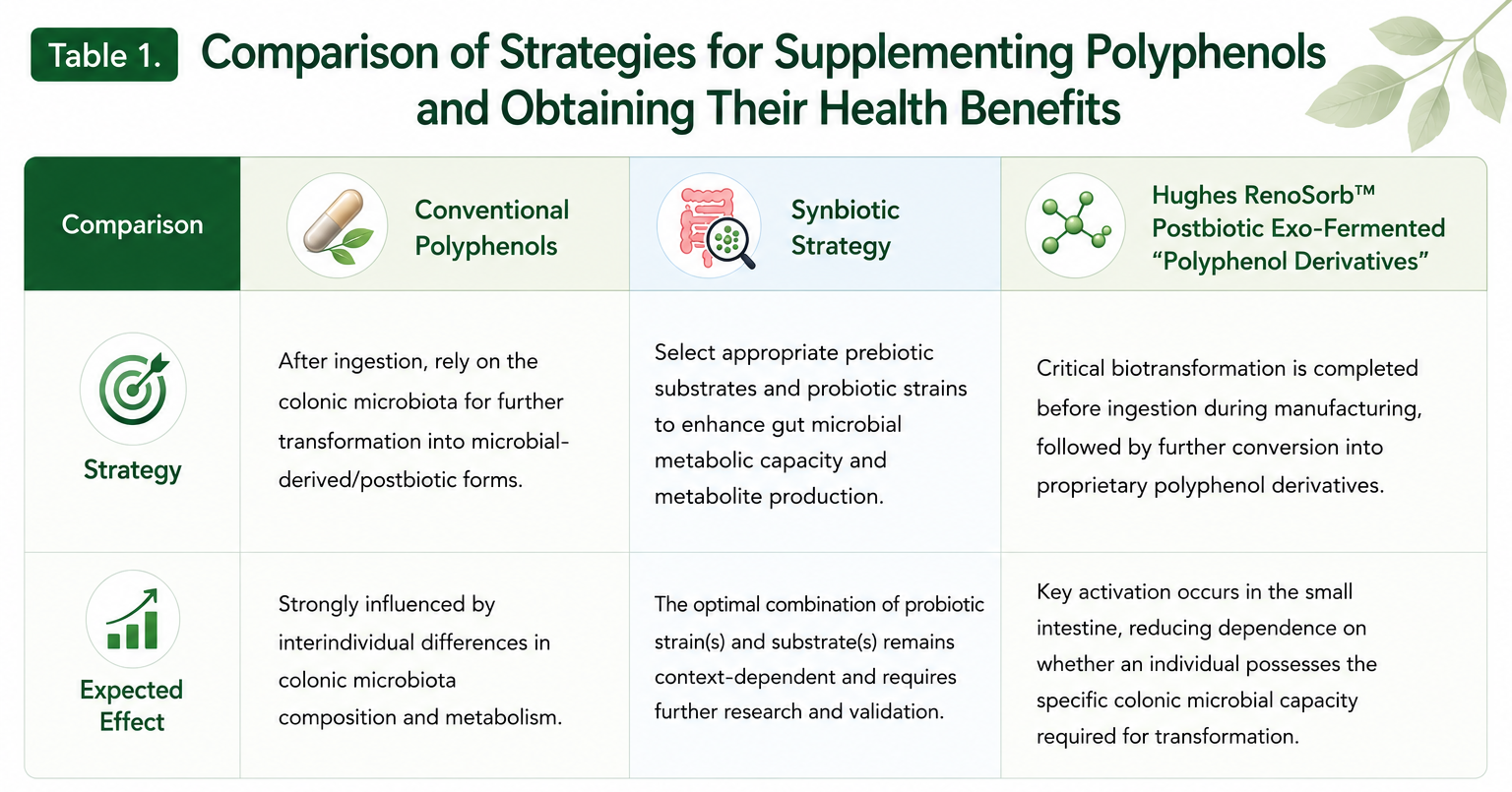
From a dietary supplement perspective, consuming more does not necessarily mean that the body can utilize more. In response to interindividual differences in gut microbiota, active-metabolite production, and health responses, nutrition science and product development have increasingly explored different strategies to reduce variability and improve the likelihood that polyphenols can deliver meaningful health benefits.
One approach is the synbiotic strategy, in which selected probiotics are paired with specific substrates or active precursors that can be utilized by microorganisms. The goal is to strengthen particular metabolic functions of the gut microbiota, increase production of target active metabolites, and reduce interindividual variability in biotransformation.
Another strategy moves the intervention one step earlier: completing the biotransformation during product manufacturing and directly supplementing the transformed active metabolite or postbiotic form. Soy isoflavones provide a representative example. In Japan, certain dietary supplements use microbial fermentation to pre-produce S-equol and provide S-equol itself as the supplemented form.
The key innovation of Hughes’s patented RenoSorb™ postbiotic exo-fermentation technology is to complete critical microbial biotransformation of plant polyphenols before ingestion and directly provide highly absorbable “polyphenol derivatives.” This establishes a distinctive pharmaceutical-grade absorption strategy designed to support precision delivery and maximize utilization of the target bioactive compound. By shifting key activation and absorption processes forward to the small intestine, RenoSorb™ products demonstrate rapid absorption, with marker derivatives detectable in the systemic circulation approximately 15 minutes after ingestion, while reducing reliance on an individual’s colonic microbial transformation capacity. Importantly, validation of RenoSorb™ extends beyond a single pharmacokinetic parameter. Representative polyphenol derivatives have undergone head-to-head human pharmacokinetic comparisons demonstrating absorption advantages, accumulated human clinical efficacy evidence, and have also notified by U.S. FDA New Dietary Ingredient Notification (NDIN). From biotransformation and mechanism of action to human absorption, clinical outcomes, safety, and regulatory evaluation, RenoSorb™ is supported by an increasingly comprehensive scientific validation framework.
Conclusion
Two forward-looking scientific reviews published in The Journal of Nutrition in 2026 together highlight an important concept reshaping polyphenol science: the effects of polyphenols depend not only on the amount consumed, but also on whether they can be effectively transformed into bioavailable active forms. Differences in the gut microbiota are a major reason why the outcomes of this transformation can vary substantially from one individual to another.
Hughes’s patented RenoSorb™ postbiotic exo-fermentation technology addresses this dependence on the gut microbiota by directly providing polyphenol derivatives that have already undergone biotransformation. The high water solubility of these derivatives is designed to overcome the natural absorption barrier of the small intestine and enhance polyphenol absorption. This mechanism aims to make absorption more efficient and more predictable, while reducing the influence of interindividual microbiota differences. By enabling more precise delivery and more efficient utilization of polyphenol bioactivity, RenoSorb™ provides an innovative practical strategy for precision nutrition and personalized health.
References
- Jiang TA, Prioult G, Quann E. Microbial Biotransformation of Polyphenols and Bioactive Substrates: Implications for Metabolite-Guided Synbiotics. The Journal of Nutrition. 2026;156:101621. doi:10.1016/j.tjnut.2026.101621.
- Vita AA, Brown J, Norby-Adams L, et al. Microbial-Derived Polyphenol Metabolites and the Gut Microbiota: A Scoping Review of Clinical Studies. The Journal of Nutrition. 2026;156:101700. doi:10.1016/j.tjnut.2026.101700.